
How Many Solar Panels Do I Need? (2026 Calculator Guide)

The Short Answer
The average American home needs 15–25 solar panels to offset its electricity usage. But that range is wide enough to be nearly useless for planning. The actual number depends on your specific electricity usage, your location's sun hours, and the wattage of the panels you choose.
This guide walks you through the exact calculation so you can arrive at a realistic estimate before you ever talk to an installer — and so you can sanity-check the proposals you receive.
The Formula
The calculation has three steps:
- Find your daily electricity usage in kilowatt-hours (kWh)
- Determine your location's peak sun hours
- Divide daily usage by daily production per panel
Written as a formula:
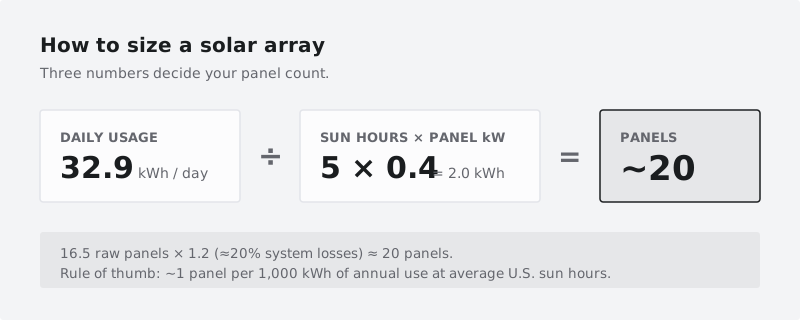
Then add ~20% for system losses to get your real-world panel count.
Step 1: Find Your Annual kWh Usage
Your electric bill shows your monthly kilowatt-hour usage. Look for a line that says something like "kWh used this month" or "energy consumed." If you can find 12 months of bills, add them together for your annual total. If you only have one bill, multiply by 12 as a rough estimate (though seasonal variation matters in extreme climates).
The U.S. average is approximately 10,500–11,000 kWh per year. But homes with electric heating, a pool, an EV, or multiple large appliances can run 18,000–25,000 kWh/year or more.
Once you have your annual total, divide by 365 to get your daily average:
- 12,000 kWh/year ÷ 365 = 32.9 kWh/day
Step 2: Find Your Peak Sun Hours
Peak sun hours are not the same as hours of daylight. A "peak sun hour" is an hour of sunlight at an intensity of 1,000 watts per square meter — the standard used in solar production calculations. Your system produces energy during most daylight hours, but peak sun hours normalize that to an equivalent number of full-intensity hours.
Approximate peak sun hours by region:
- Southwest (AZ, NM, Southern CA, NV): 5.5–7 hours
- Southeast and Texas: 4.5–5.5 hours
- Pacific Northwest and Great Lakes: 3–4 hours
- Northeast: 3.5–4.5 hours
- Midwest: 4–5 hours
Your installer will use detailed solar irradiance data (often from the NREL PVWatts tool) for your specific address and roof orientation. For this estimate, use the middle of your region's range.
Step 3: Calculate Panel Count
Modern residential solar panels typically range from 380 to 450 watts. High-efficiency panels (SunPower, REC Alpha) run 400–450W. Standard efficiency panels run 380–410W. For this calculation, use 400W (0.4 kW) as a conservative middle estimate.
Daily production per panel = Peak sun hours × Panel wattage in kW
- 5 peak sun hours × 0.4 kW = 2.0 kWh/day per panel
Now divide your daily usage by daily production per panel:
- 32.9 kWh/day ÷ 2.0 kWh/panel/day = 16.5 panels
Annual usage: 12,000 kWh → 32.9 kWh/day
Location: Texas (5 peak sun hours)
Panel: 400W (0.4 kW)
Base calculation: 32.9 ÷ (5 × 0.4) = 16.5 panels
After 20% system losses: 16.5 × 1.2 = ~20 panels
Add 20% for System Losses
Real-world solar systems lose some energy to heat, wiring resistance, inverter conversion inefficiency, soiling, and shading. The standard assumption is approximately 20% total system losses. To account for this, multiply your raw panel count by 1.2:
- 16.5 panels × 1.2 = 19.8 → 20 panels
This is why a good installer's proposal will show a slightly larger system than your raw usage math suggests — they are accounting for real-world production losses to ensure the system actually offsets your full usage.
Key Variables That Shift the Number
Several factors will move your panel count up or down from the base calculation:
- Roof angle and azimuth: A south-facing roof at a 20–30 degree pitch is optimal in most U.S. locations. East/west-facing roofs produce 10–20% less, requiring more panels for the same output.
- Shading: Even partial shading during peak hours significantly reduces production. Microinverters or power optimizers can mitigate this, but shading always costs something.
- Panel efficiency: Premium panels (400–450W) mean fewer panels for the same output. Older or budget panels (350–380W) require more roof space.
- Goal offset: Most homeowners target 95–100% offset of their current usage. If you plan to add an EV, budget for that additional usage now.
Battery Storage Sizing
If you are adding battery storage, a common starting point is to cover one to two days of your essential loads (refrigerator, lights, basic outlets, internet router). A typical home's essential loads run 5–10 kWh/day. Two days of backup coverage means 10–20 kWh of battery storage — one or two Tesla Powerwalls (13.5 kWh each), or a comparable Enphase IQ battery system.
If whole-home backup is the goal, size the battery to match your full daily average: a 30–35 kWh battery bank for the 32.9 kWh/day example above. This significantly increases system cost but provides true energy independence.
Every 1,000 kWh/year of electricity usage ≈ 1 additional solar panel (at average U.S. sun hours).
10,000 kWh/year → ~10–12 panels before losses → ~12–15 panels in real world.
Why You Still Need Professional Quotes
This calculation gives you a solid estimate for planning and for evaluating proposals — but it cannot replace a professional site assessment. An installer will evaluate your specific roof, perform a shading analysis using satellite data and horizon tools, check your electrical panel capacity, and run production modeling software (typically NREL PVWatts or Aurora Solar) that accounts for all local variables.
Getting multiple quotes also ensures you see different system designs and can choose the one that balances production, cost, and aesthetics for your home.
Typical panel count and system cost by home electricity use
| Annual usage | Panels (≈400W) | System size | Estimated installed cost |
|---|---|---|---|
| 6,000 kWh | 8–10 | 3.5 kW | $10,500–$12,500 |
| 10,000 kWh | 13–16 | 6.0 kW | $17,000–$21,000 |
| 14,000 kWh | 18–22 | 8.5 kW | $24,000–$30,000 |
| 20,000 kWh | 26–32 | 12.0 kW | $34,000–$42,000 |
Estimates assume average U.S. sun hours and ~20% system losses. Your actual count depends on roof orientation, shading, and panel efficiency.
Frequently asked questions
Most U.S. homes need about 15 to 25 panels to offset their electricity use. The exact number depends on your annual kWh usage, your local peak sun hours, and the wattage of the panels you choose. A useful rule of thumb is roughly one panel per 1,000 kWh of annual usage at average sun hours.
Ready to Compare Solar Quotes?
Get free, no-obligation quotes from top-rated installers in your area — and see exactly how a custom system would be sized for your home.
Get Free Solar Quotes