
Solar Inverters Explained: String vs Micro vs Hybrid (2026)
The Component Everyone Ignores
Homeowners obsess over panels and forget the inverter. That's backwards. Panels rarely fail. The inverter is the single component most likely to break during your system's life, and the type you choose shapes your production, your monitoring, and your repair bills for the next two decades.
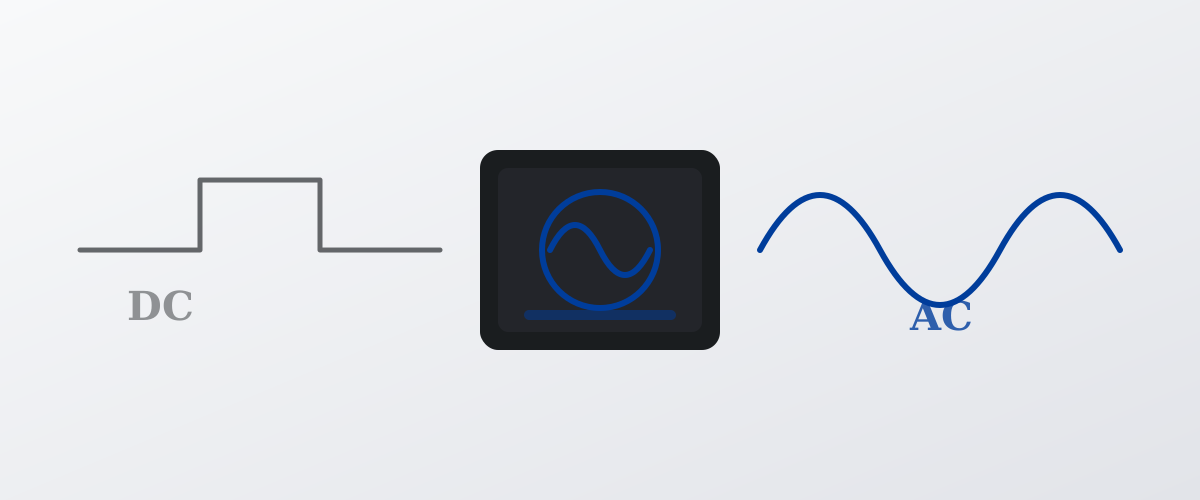
The inverter does one essential job: solar panels produce direct current (DC), but your home and the grid run on alternating current (AC). The inverter converts one to the other. How it does that — and where it sits in the system — is the whole debate.
Three Architectures, Three Trade-offs
String Inverters
The traditional setup. Your panels are wired in series into one or two "strings," and all that DC power runs down to a single inverter box mounted near your electrical panel. One device does all the conversion.
The strengths: cheapest option, simplest design, and one accessible box if something needs service. A quality string inverter runs $1,000–$2,000 for a typical home.
The catch: a string is only as strong as its weakest panel. If one panel sits in shade or collects leaves, it can drag down the output of every panel on that string. On an unshaded, single-plane roof facing one direction, that's a non-issue. On a complex or shaded roof, it's a real cost.
Microinverters
Flip the model. Instead of one big inverter, a small microinverter sits under each individual panel and converts that panel's DC to AC right there on the roof.
The strengths: each panel operates independently, so shade on one panel doesn't touch the others. You get panel-level monitoring — you can see in an app exactly which panel is underperforming. They handle complex roofs with multiple angles and orientations gracefully. Enphase dominates this category.
The catch: cost. Microinverters add $1,000–$3,000 to a typical system versus a string inverter. And you now have 20-some electronic devices on the roof instead of one in the garage — though modern units carry 25-year warranties to match the panels.
Power Optimizers (the middle path)
A hybrid of the two. Small optimizers sit under each panel and condition the DC, but a central string inverter still does the DC-to-AC conversion. SolarEdge built its business here.
You get most of the per-panel benefits — shade tolerance, panel-level monitoring — while keeping a single inverter to convert the power. The downside: you depend on both the optimizers and the central inverter working, so there are more parts in the chain.
Simple roof, one direction, no shade → string inverter saves money with no real downside.
Multiple roof angles, any shading, or you want per-panel data → microinverters or optimizers earn their cost.
Hybrid Inverters and the Battery Question
"Hybrid inverter" means something specific: an inverter built to manage both solar panels and a battery, handling the flow of energy between panels, battery, home, and grid in one unit. If you're adding storage now or expect to within a few years, a hybrid inverter is worth planning for.
The alternative is "AC coupling" — bolting a battery with its own inverter onto an existing solar system later. It works, but it adds a second conversion step and some efficiency loss. Installing a hybrid (or DC-coupled) setup from the start is cleaner and slightly more efficient. If a battery is anywhere in your plans, raise it before the system is designed.
The Clipping Detail Worth Knowing
Inverters are sized by their AC output, and that size doesn't have to match your panels' DC capacity. Installers often pair, say, 8 kW of panels with a 7 kW inverter. The ratio is the DC-to-AC ratio, and a value around 1.1 to 1.25 is normal and good.
Why undersize on purpose? Panels rarely hit their full rated output, so a slightly smaller inverter captures nearly all the real-world energy at lower cost. The trade-off is "clipping" — on the brightest few hours of the sunniest days, the inverter caps output and a sliver of potential energy is lost. For most homes that loss is under 2% a year, and the inverter savings more than cover it. Be wary of a quote with a ratio above 1.3 or below 1.05; ask the installer to explain it.
Why Inverters Fail and How You'll Know
Inverters work harder than any other part of your system. They run hot, switch constantly, and convert power every daylight hour for decades. That's why they're the component most likely to need replacing. A string inverter mounted in a hot garage or in direct sun ages faster, so placement in a shaded, ventilated spot genuinely extends its life — worth raising with your installer.
The good news is that failures rarely strand you. A central inverter usually announces itself: production drops to zero, the monitoring app flags it, and a fault light comes on. Replacement is a swap of one box, typically a half-day job. Microinverter failures are subtler — one panel quietly underperforms while the rest carry on — which is exactly why panel-level monitoring pays off. You catch the bad unit instead of losing its output for a year.
Brands That Earn Trust
- Enphase — the microinverter standard. Excellent monitoring, 25-year warranties, and a strong reliability record. The default for shaded or complex roofs.
- SolarEdge — the optimizer leader, with strong hybrid options for battery systems. Watch the central inverter warranty; it's often 12 years standard, extendable to 25.
- SMA — a string-inverter veteran known for German engineering and reliability. A solid pick for simple roofs.
- Tesla / Fronius — Tesla's inverter pairs naturally with Powerwall; Fronius offers reliable string units with good service support.
What Each Type Costs on a Real System
On a typical 8 kW residential install, here's the rough inverter spend you're choosing between:
| Type | Added Cost | Typical Warranty | Shade Handling |
|---|---|---|---|
| String | $1,000–$2,000 | 10–12 yr | Poor |
| Optimizers + string | $1,800–$3,000 | 12–25 yr | Good |
| Microinverters | $2,000–$3,500 | 25 yr | Excellent |
| Hybrid (battery-ready) | $1,500–$3,000 | 10–25 yr | Varies |
The spread between cheapest and priciest is roughly $2,000 over the system's life — meaningful, but small next to the production you lose if you put a shade-blind string inverter on a tree-shaded roof. Spend the money where your roof demands it.
Monitoring Is Half the Value
An inverter doesn't just convert power; it reports on your system. This matters more than buyers expect. Without monitoring, a dead panel or a failing connection can go unnoticed for months, quietly costing you energy you've already paid for.
String inverters give you system-level data: total output, and an alert if the whole thing goes down. Microinverters and optimizers give you panel-level data — you can open an app and see that panel 14 has been underproducing since a storm dropped a branch on it. For a complex roof, or for anyone who wants to actually verify the system is doing its job, panel-level monitoring is worth real money. Ask to see the monitoring app before you buy; you'll be looking at it for 25 years.
The Warranty Trap to Avoid
Here's the mismatch that bites people: your panels carry a 25-year warranty, but a basic string inverter warranty is often only 10–12 years. That means you'll likely replace the inverter at least once during the system's life — budget $1,500–$2,500 for that eventual swap, plus labor. Microinverters and premium hybrids usually carry 25-year warranties that match the panels, which is part of what you're paying for. Always confirm the inverter warranty term in writing; it's easy to assume it matches the panels when it doesn't.
If you do go with a string inverter, ask whether an extended warranty to 20 or 25 years is available and what it costs. Often it's a few hundred dollars up front — cheaper than a future replacement and the service call that comes with it.
Ready to Compare Solar Quotes?
Get free, no-obligation quotes from top-rated installers in your area — and see exactly how a custom system would be sized for your home.
Get Free Solar Quotes